Are slippers mandatory in daycare? Orthopedics and rules fact-checked
At a glance:
The requirement for slippers in daycare combines legal safety requirements for fall prevention with the medical needs of growing children’s feet.
They are usually at the very top of the equipment list for daycare: slippers. Many parents are rightly surprised by this. Why should the child wear sturdy shoes in the facility? After all, children usually run around barefoot at home. The answer to this question is an exciting balancing act. It involves strict insurance requirements, basic hygiene, and children’s natural urge to feel the world intensely. Let’s take a closer look at the legal requirements and medical facts to find the perfect solution for everyday daycare life.
The safety aspect: Which accident prevention regulations actually apply?
When you drop your child off with the group in the morning, the duty of care is transferred completely to the educators. At the same time, the strict regulations of the statutory accident insurance (DGUV) take effect. These accident prevention regulations clearly require facilities to consistently minimize potential tripping and slipping accidents. Suitable indoor footwear plays a central role in this. In daycares, children often mess around with watercolors, or water ends up on the floor in the washroom. The risk of injury from slipping increases enormously there. Additionally, protective soles protect toes from sharp Lego bricks or the accidental step of a playmate. While there is no nationwide, legally anchored requirement for slippers, the providers effectively protect themselves through their own house rules. In this way, they fulfill the requirements of the professional associations and create a safe environment.
Requirements set by daycare centers: Can a daycare center require certain models?
Often, very specific clothing requirements are posted on the facility’s bulletin board. In principle, the management is entitled to set guidelines within the framework of their domiciliary rights. These requirements only need to serve general safety and smooth operations. For example, completely open sandals or models with complicated laces are often taboo. They increase the risk of accidents or hinder the children’s important independence when putting them on and taking them off.
❌ Myth: Daycares can force parents to buy only classic, sturdy felt slippers with a strongly shaped footbed.
✔ Fact: A daycare may only insist on safe, non-slip, and supportive properties, but never enforce orthopedically outdated formats or specific brands.
Barefoot or shoes: What is best for foot health?
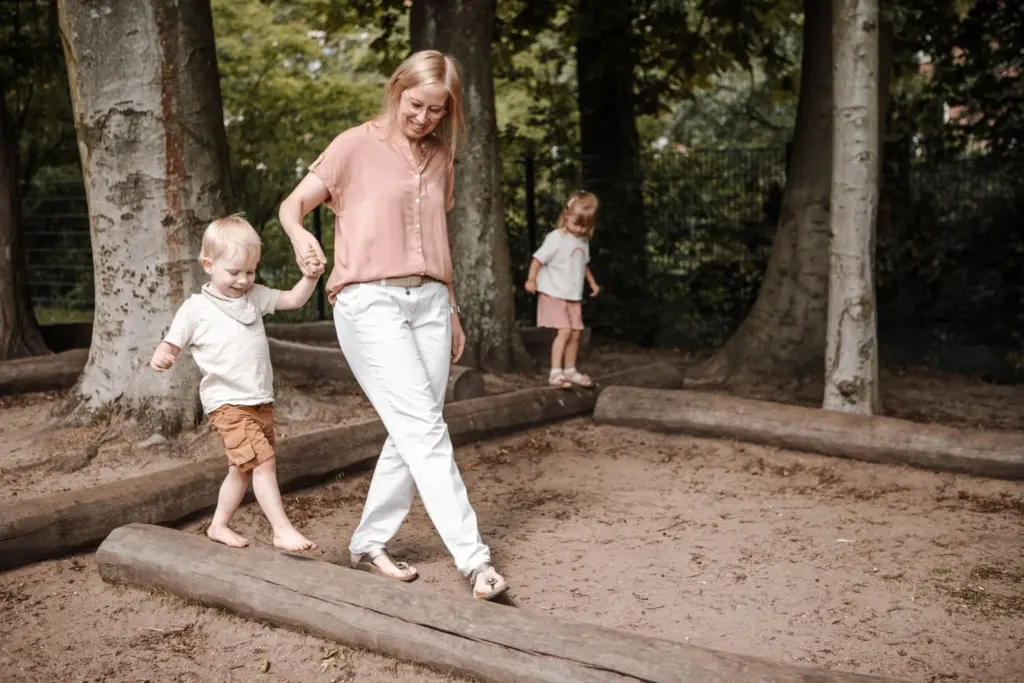
While statutory accident insurance primarily looks at protection against acute injuries, doctors focus on the long-term development of children’s feet. Children are born with soft, cartilaginous feet. They must first actively build up their supporting muscles through diverse loads and movement stimuli. For this very reason, pediatric orthopedists repeatedly and emphatically advise going barefoot. Feeling and gripping with bare toes strengthens the arch of the foot in a completely natural way. This is extremely effective in preventing later misalignments or flat feet. If, on the other hand, small feet are pressed into a rigid corset of thick felt for eight hours a day, these important muscles wither. Feet need space, flexibility, and direct contact with the ground to grow healthily.
The perfect compromise: Are non-slip socks a permitted alternative?
Many parents therefore consciously look for a healthy middle ground. This should fulfill the daycare’s strict requirements for slip resistance without disturbing motor development. This is where the popular non-slip socks or thin leather moccasins come into play. In the vast majority of modern facilities, these flexible models are absolutely recognized as slippers for daycare. They form a wonderful alternative to the classic, stiff slipper. Thanks to the rubberized soles, they offer enough grip on smooth linoleum or wooden floors. At the same time, they give the toes the necessary freedom for their important gripping work with every step.
💬 Expert assessment: “A good daycare slipper should feel like a second skin and should never artificially support the arch of the foot. The softer and more flexible the sole, the better for the child’s sensory and motor development.” – Miriam Roth
What matters for the perfect equipment
To ensure that the balancing act between safety and healthy physical development succeeds smoothly, it is worth taking a close look when buying shoes. Make sure that the materials are breathable. Children’s feet sweat very quickly due to high daily activity. In completely closed synthetic models, this quickly leads to an unpleasant foot climate and potentially skin irritation. Velcro fasteners or elastic cuffs are ideal, as they strengthen your child’s autonomy and avoid frustration when putting them on independently.
Tip:
Do the bend test right in the store: Can you effortlessly bend and twist the sole of the slipper in all directions with two fingers? Only if it is extremely soft and flexible does it allow the child’s foot the important, natural rolling motion.
Conclusion: Are slippers mandatory in daycare?
The seemingly trivial question of the right indoor footwear turns out to be a fascinating balancing act between legal protection and orthopedic necessity. For reasons of accident prevention and hygiene, daycares must insist on non-slip soles and minimal protection. At the same time, optimal foot health requires maximum freedom for growing muscles and tendons. By choosing extremely soft leather moccasins or high-quality non-slip socks, you master this challenge perfectly. You easily fulfill the educators’ safety requirements and give your child’s feet exactly the freedom they need for healthy development.
Disclaimer: The information provided in this article is for general educational and informational purposes only. It does not replace individual professional advice. For specific questions or concerns, a qualified expert from the relevant field should always be consulted.
👤 About the Author
Miriam Roth is a recognized specialist in social management and early childhood pedagogy, drawing her profound expertise from intensive support and consulting for educational institutions. As a freelance specialist author and systemic consultant, she writes in-depth articles focusing on personnel development, concept work, and quality management in daycare centers. Thanks to her ability to seamlessly link theoretical expertise with the practical challenges of everyday daycare life, she has established herself as a sought-after voice for contemporary leadership concepts in the social sector.
Sources
- German Statutory Accident Insurance (DGUV) – Guidelines for accident prevention in daycare facilities
- Professional Association of Specialists in Orthopedics and Trauma Surgery (BVOU) – Statements on childhood foot health